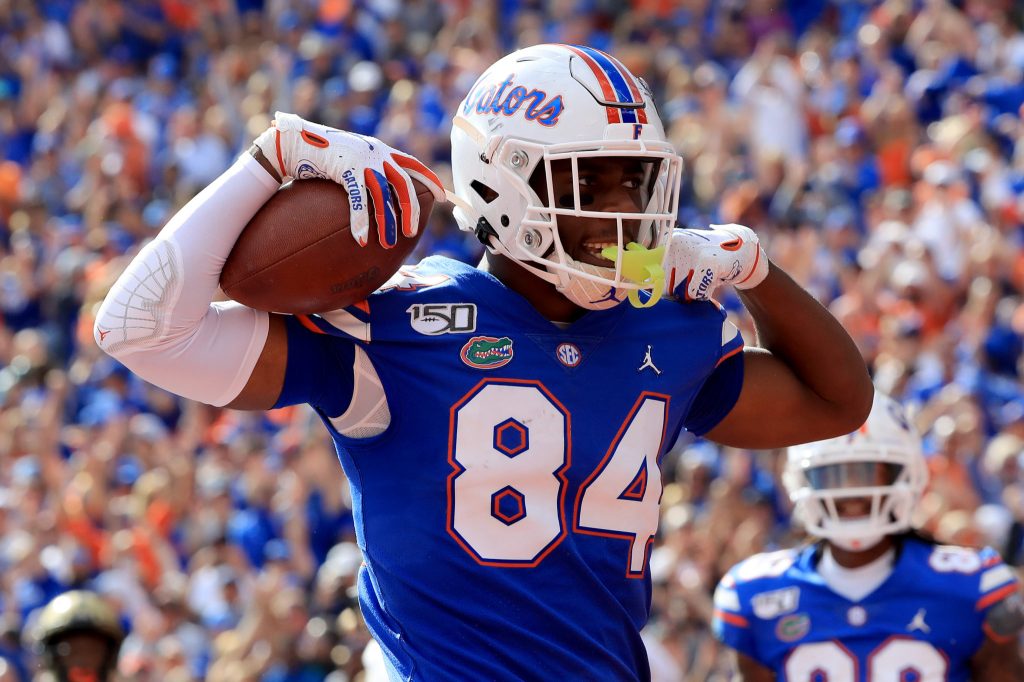
Statistics provided by PlayerProfiler.com
Quarterback:
Tier 1 ———————
1. Trevor Lawrence, Clemson
2. Justin Fields, Ohio State
Tier 2 ———————
3. Trey Lance, North Dakota State
4. Mac Jones, Alabama
5. Zach Wilson, BYU
Tier 3 ———————
6. Kyle Trask, Florida
7. Kellen Mond
8. Jamie Newman, Georgia
9. Sam Ehlinger, Texas
10. Ian Book, Notre Dame
.
Running Back:
Tier 1 ———————
1. Najee Harris, Alabama
During his first two seasons at Alabama, Harris was stuck behind Josh Jacobs and Damien Harris, but when those two left for the NFL in 2019, Harris went on to post elite production as the team’s workhorse during his junior and senior seasons. Harris’ combination of size, strength, balance and agility make him a great prospect as a runner alone, but he also boasts some of the best hands in the 2021 class. Even though he’ll play his first NFL down at 23 years-old, Harris is one of the few cornerstone running back assets available in 2021 rookie drafts.
2. Travis Etienne, Clemson
Etienne produced early and often at Clemson, but his unspectacular senior season — largely due to poor play from his offensive line — hurt his stock in the eyes of many. This is good news for us, though. While the skeptics fade, we collect more shares at a discounted price. Etienne’s early college production is undeniable, and it’s worth remembering he was in the same conversation as last season’s rookie RB1 Jonathan Taylor in a loaded running back class. He’s the only back among the big three who possesses breakaway speed and can house one anytime. Etienne’s critics claim he won’t handle a large workload between the tackles due to his smaller frame and questionable vision at times, but those concerns are overblown. Trust the production. Etienne is often compared to Alvin Kamara, as he may not be built to carry the ball 20 times a game, but he more than makes up for it in the receiving game. While Kamara is a rare back, Etienne compares well, and he fits the bill to be next in line as one of the NFL’s new-school receiving backs, and he makes for the second-best pick at running back in the first round of rookie drafts.
Tier 2 ———————
3. Javonte Williams, North Carolina
Williams emerged as the clear-cut No. 3 running back in the class after a strong junior season in which he racked up 1,140 yards and 19 touchdowns on the ground while adding 25 receptions for 305 yards and three touchdowns in the receiving game. There’s a lot to like about Williams. He started making noise as a sophomore before following it up with a true breakout season as a 20-year-old junior. He’ll take his first NFL snap at 21 years-old, and after refining his receiving skills this past season, Williams is poised to take on a three-down role in the NFL. Williams is your dad’s favorite runner, always churning his legs and falling forward at the end of runs. His low, physical style paired with outstanding balance allows him to bounce off tackles, though he lacks the explosiveness of an Etienne and likely won’t house many long ones due to his speed. Williams rounds out the top three running backs that managers should be clamoring to get their hands on. Everyone past these three comes with more risk.
Tier 3 ———————
4. Kenny Gainwell, Memphis
As a redshirt freshman in 2019, Gainwell posted 2,069 yards from scrimmage and 16 total touchdowns while keeping fellow teammate Antonio Gibson off the field. A poor man’s Christian McCaffrey, Gainwell’s dual-threat ability gives him staying power in the modern NFL. Concerns with Gainwell revolve around his 5’11, 205-pound frame and whether he’s capable of handling early-down work at the next level. Conventional wisdom suggests whoever drafts Gainwell likes his skillset and will want to feature him in the backfield, so hopes remain high for his NFL future. Given his upside, Gainwell is worthy of a selection at the turn of the first round in rookie drafts, but he can also be found in the middle of the second round.
5. Kylin Hill, Mississippi State
After rushing for 734 yards and four touchdowns on 6.3 yards per carry as a true sophomore, Hill broke out as a junior, rushing for 1,350 yards and 10 touchdowns on 5.6 yards per carry while adding 18 receptions for 180 yards and a score through the air during a full 13-game season. In 2020, Mike Leach arrived with his air-raid offense and would have turned Hill into a PPR darling had he played the entire season. In his two full games, Hill caught 23 of 29 targets for 237 yards and a touchdown. After a strong start to the season, Hill was hit with a suspension for undisclosed reasons before ultimately opting out of the rest of the year to focus on his draft prep. Hill is well-built and a decisive runner between the tackles. He fits the three-down mold, and he’ll be an excellent value in the second or third round of rookie drafts.
6. Jermar Jefferson, Oregon State
As a true freshman in 2018, Jefferson broke the single-season rushing record at Oregon State, carrying the ball 239 times for 1,380 yards and 12 touchdowns while adding 25 receptions for 147 yards. He went on to record 1,543 yards and 17 touchdowns on 5.6 yards per carry in 14 games over his next two seasons. Jefferson’s well-built frame and college production appear to give him a high floor, however his 43 receptions on 57 targets across three seasons leaves his ability as a receiver somewhat unproven. He’s a fluid athlete with good hands on tape, so it’s not a major concern, and ultimately it may just come down to which quarterback he’s tied to in the pros.
7. Chuba Hubbard, Oklahoma State
After rushing for over 2,094 yards and 21 touchdowns as a redshirt sophomore in 2019, Hubbard made a questionable decision to return to school in 2020. He suffered an ankle injury early in November that hampered his play down the stretch, as his yards per carry average dropped from 6.4 in 2019 to 4.7 in 2020. He continued to show deficiencies as a receiver and pass protector as well. Hubbard is patient, has good vision and runs to leverage, but he’s not very elusive and is more a one-cut runner. Even though Hubbard seems to lack three-down potential, his elite speed will be attractive to teams, and he could find himself with a decent amount of early-down work in the NFL.
8. Michael Carter, North Carolina
Carter produced efficiently across all four years at North Carolina, though he saw his most work during his final two seasons — even while sharing the backfield with another top prospect in Javonte Williams. Carter posted 2,248 yards on 6.8 yards per carry and 12 touchdowns over his final two years, displaying great vision, burst and elusiveness along the way. At 5’8, 202 pounds, he’s not the ideal size to handle a large workload between the tackles, but he can make up for it in the receiving game, and that’s what drives his upside. Carter caught 82 of 100 targets during his career and shows great play-making ability after the catch. Carter won’t be a bell cow by any means in the pros, but his ceiling is a high-end RB2 like Aaron Jones, whose efficiency will make up for a lack of volume.
Tier 4 ———————
9. Trey Sermon, Ohio State
Sermon spent his first three seasons at Oklahoma, rushing for 2,076 yards and 22 touchdowns over 37 games while splitting time with Kennedy Brooks and eventually Rhamondre Stevenson. A knee injury forced him to miss the final four games of the 2019 season, and, with the backfield getting crowded, he transferred to Ohio State the following spring in search of a better life. Master Teague’s presence limited Sermon’s opportunity for most of the Buckeyes’ shortened season, until Teague suffered an injury in the Big Ten Championship game. Sermon took full advantage, rushing for 331 yards and two touchdowns on 29 carries, breaking the program’s single-game rushing record previously held by Eddie George. He went on to beat up Clemson the following week in the CFP Semifinal game, rushing for 193 yards and a score on the ground while adding four catches for 61 yards through the air. Sermon was efficient during his final two seasons, posting over 7.0 yards per carry, but it’s worth noting he played alongside mobile, Heisman-contending quarterbacks in Jalen Hurts and Justin Fields over those two seasons, which may have opened things up for Sermon more than a typical QB would. Nonetheless, Sermon is a bruiser with the frame of an NFL workhorse, though his ceiling in the pros will be capped by his lack of speed and limited receiving prowess.
10. Rhamondre Stevenson, Oklahoma
Stevenson was an unranked prospect coming out of high school after a broken foot during his senior year threw a wrench in things. He spent two years playing junior ball at Cerritos College before transferring to Oklahoma. Stevenson showed promise during his first season with the Sooners, rushing for 515 yards and six touchdowns on 8.0 yards per carry while biding his time behind Trey Sermon and Kennedy Brooks. In 2020, Sermon decided to transfer to Ohio State, opening the door for a full Stevenson breakout. Stevenson proceeded to miss the first five games of the season due to a failed drug test, but he made the most of six games, rumbling for 665 yards and seven touchdowns on 101 carries while adding 18 receptions for 211 yards through the air. Stevenson is surprisingly agile and quick on his feet for someone his size, though he has just average speed, running a 4.63 at his pro day. His ceiling remains high, though, as he’s effective in the receiving game and excels in pass protection, giving him three-down potential in the NFL. A rich man’s Leonard Fournette, Stevenson makes for a solid pick in the third or fourth round of rookie drafts.
11. Jaret Patterson, Buffalo
12. Elijah Mitchell, UL-Lafayette
13. Larry Rountree, Missouri
14. Javian Hawkins, Louisville
Tier 5 ———————
15. Rakeem Boyd, Arkansas
16. Spencer Brown, Alabama-Birmingham
17. Khalil Herbert, Virginia Tech
18. C.J. Marable, Coastal Carolina
19. Stevie Scott, Indiana
20. Pooka Williams, Kansas
.
Wide Receiver:
Tier 1 ———————
1. Ja’Marr Chase, LSU

As a sophomore, Chase led the team in receiving during LSU’s historic 2019 campaign, catching 84 passes for 1,780 yards and 20 touchdowns en route to winning the Biletnikoff Award for the nation’s top wideout. He chose to sit out of the 2020 season and focus on the 2021 NFL Draft, where he’ll likely be among the top three receivers taken. Despite not having great height at 6’0, he’s a sturdy 208 pounds and is the most complete prospect as both a physical and finesse player who makes defenders pay in a variety of ways. He’s excellent on the outside and makes his money downfield, but he’s also good in the underneath and intermediate game as a fluid route-runner. He’s strong and has great hands — most notably in contested situations — making him an all-around prospect who appears to be a lock to produce at a high level in the pros.
2. Rashod Bateman, Minnesota
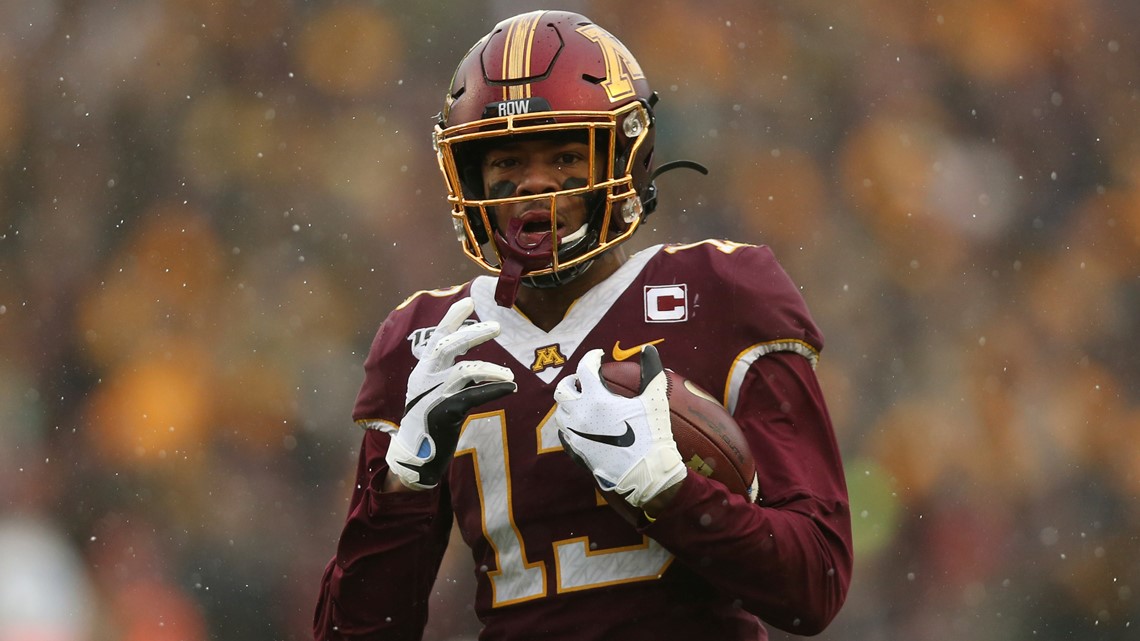
There’s a lot to love about Bateman from both a statistical and tape perspective. He commanded a 27.2% target share as a freshman in 2018, recording 51 receptions, 704 yards and six touchdowns. He followed it up with a greater 2019, compiling 1,219 yards and 11 touchdowns on just 60 catches (20.3 YPC). Bateman accomplished this while playing alongside future pro Tyler Johnson. In 2020, Bateman played in only five games during a messy Big Ten season before opting out in November, but he looked like the same player, and it was enough to cement his place as a top receiving prospect. He checks every box for important predictive metrics like breakout age (19), target share (30.4%) and overall college production, but that’s only half the excitement. What he shows on the field only adds to the hype. Bateman’s release package and crisp route-running make him an excellent separator, while his strong hands and toughness on contested catches make him an all-around receiver and a high-floor prospect. He’s got the textbook alpha frame at 6’2, 210 pounds and should have no trouble playing on the outside at the next level. Despite lacking elite speed, Bateman excels everywhere else and fits the profile of the next Keenan Allen or Davante Adams.
Tier 2 ———————
3. Jaylen Waddle, Alabama
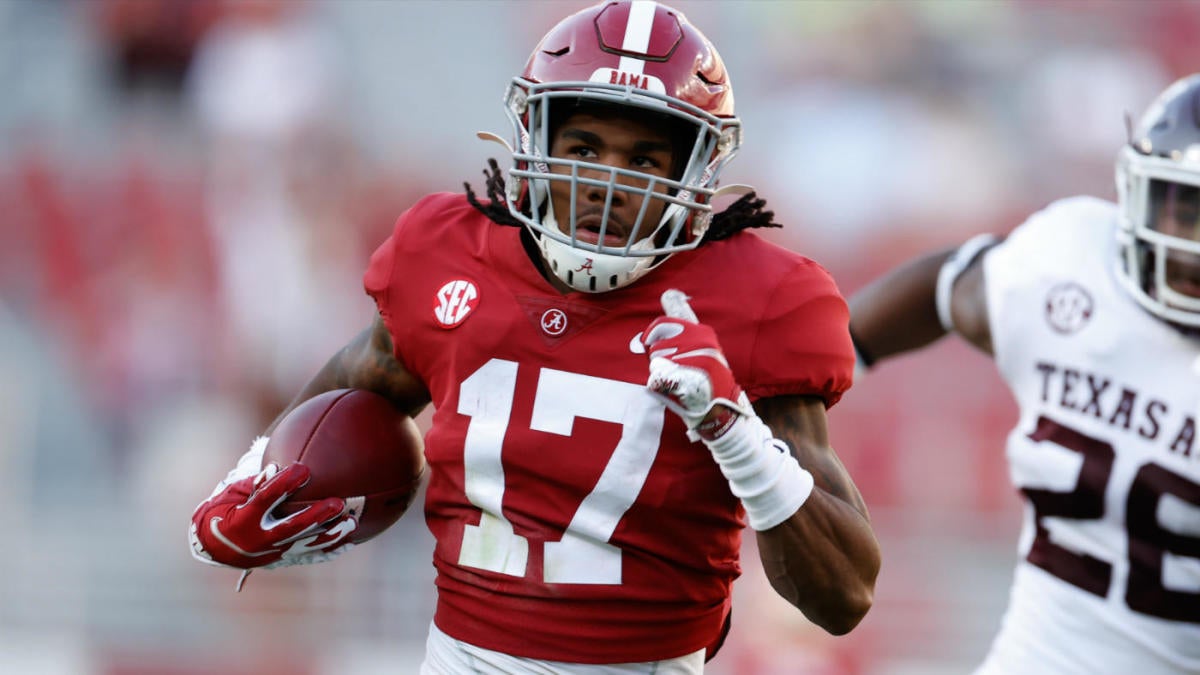
If it weren’t for a season-ending ankle injury early in the season, Mac Jones would’ve won the Heisman, and Waddle would be challenging to be the top receiver off the board in the 2021 NFL Draft. Through four games in 2020, Waddle led the team in receiving with 25 grabs for 557 yards and four touchdowns. Waddle’s explosive combo of speed and quickness gives teams a great slot target capable of turning short passes into long gains, but he’s even more dangerous on the outside as a deep threat. Despite his 5’10 frame, Waddle “plays big” and can go up and get it in traffic thanks to his big vertical and strong hands. It’s worth noting DeVonta Smith still captured more of the team’s target share during the four games as well as in 2019, but Waddle’s targets were more valuable than Smith’s, as Waddle’s average depth of target (aDOT) was much higher than Smith’s. Such will be the case in the pros, and I find Waddle’s more typical profile to be the safer bet compared to Smith’s.
4. Terrace Marshall, LSU

Marshall served as the third option behind teammates Ja’Marr Chase and Justin Jefferson on the loaded 2019 National Championship team, recording 46 receptions for 671 yards and 13 touchdowns as a 19-year-old sophomore. He returned to school in 2020, but poor quarterback play, a depleted team and a mid-season injury made his junior campaign less spectacular than many hoped before ultimately ending in a November opt-out. Still, Marshall showcased his potential, finishing with three games over 100 yards — one of which was an 11-catch, 235-yard and three-touchdown performance against Missouri. He continued to show his prowess in the red zone, hauling in 10 touchdowns over just seven games. The lack of complete college production compared to his contemporaries may depress his draft value, but that’s good news for the rest of us. Marshall’s size and speed paired with a rather complete route tree make him a promising prospect. The main concern with Marshall’s profile is his inability to establish himself as a target hog during college. While we can easily brush aside his small target-share of 10.8% in 2019 with Chase and Jefferson, his 2020 share of 16.6% is more puzzling. The addition of five-star freshman receiver Kayshon Boutte certainly played a role, and I’ll chalk the rest up to inconsistency from a raw prospect and poor quarterback play. Overall, fading someone with Marshall’s potential would be an egregious mistake given his potential to be a top 3 wideout from this class.
5. DeVonta Smith, Alabama
Smith spent the early portion of his career competing for targets with the likes of Calvin Ridley, Henry Ruggs, Jerry Jeudy and Jaylen Waddle. He broke out his junior year, leading the team in receiving with 1,256 yards and 14 touchdowns on 68 receptions. He decided to return for his senior season to increase his draft stock, and it proved highly beneficial, as he won the Heisman Trophy while locking himself in as an early-first-round pick after posting an outlandish 1,856 yards and 23 touchdowns on 117 receptions. Waddle’s absence led the team to funnel targets Smith’s way, but the argument goes both ways. Teams knew it was coming, yet they still couldn’t stop him. Smith wasn’t playing against slouches, either. He showed out against future pros, most notably Derrick Stingley Jr. (LSU), Eric Stokes (Georgia) and Tyson Campbell (Georgia). A common knock on Smith is his frame, playing at 6’1, 175 pounds as a 22-year-old senior. He refused to weigh in at the Senior Bowl in January, though, which suggests he could have been playing even lighter. That’s a red flag, but Smith’s elite production (even when adjusted for age) paired with his complete skillset should not be swept aside just because he’s light on the scale. It’s seems unlikely he reaches the same heights he did in college, but he figures to enjoy success in the pros. I’ll just take the prototypical alpha profiles first.
6. Rondale Moore, Purdue
As an 18-year-old in 2018, Moore posted one of the most impressive freshman campaigns in college football history, recording 1,258 yards and 12 touchdowns on 114 receptions across 13 games. Hamstring and knee injuries limited him to just seven games over his final two seasons, though he continued to dominate the team’s target share and show scouts his huge ceiling. He has a small but dense frame at 5’7, 180 pounds, which has led some to question his ability to compete on the outside in the NFL. Fortunately for Moore, his 4.3 speed keeps defenses honest, but where he really makes his money is underneath. Moore thrives after the catch, using his outlandish strength and athleticism to embarrass defenders. The man has done nothing but produce at an elite level when on the field, and he makes for an excellent pick at the turn of the first round in rookie drafts.
Tier 3 ———————
7. Elijah Moore, Ole Miss
Moore managed to carve out an 11.3% target share and post 400 yards receiving as a true freshman while sharing the field with D.K. Metcalf and A.J. Brown at Ole Miss. Upon their departure to the NFL, Moore instantly became the alpha for the next two seasons, capturing over 30% of his team’s targets while posting 153 receptions for 2,043 yards and 14 touchdowns over that span. Moore is an excellent route-runner with good hands who adds value after the catch as well. The main concern around Moore is his size and whether he’ll be cast into purely a slot role, which will limit his opportunities when the team is in two-receiver sets. This will partly depend on where he lands, though he’s proven himself capable on the outside, as he saw 60 non-slot snaps in and was targeted on 30 of them, posting 25 receptions, 303 yards and two touchdowns. If Moore is drafted within the first two rounds of the NFL Draft, that’s a good sign his team plans to keep him on the field. Moore is another wideout who did nothing but produce in college, and he makes for a good pick in the second round of rookie drafts.
8. Dyami Brown, North Carolina
9. Amon-Ra St. Brown, USC
10. Tamorrion Terry, Florida State
11. Tylan Wallace, Oklahoma State
Tier 4 ———————
12. Seth Williams, Auburn
13. Amari Rodgers, Clemson
14. Kadarius Toney, Florida
Tier 5 ———————
16. Nico Collins, Michigan
17. Damonte Coxie, Memphis
Tier 6 ———————
18. Marquez Stevenson, Houston
19. D’Wayne Eskridge, Western Michigan
20. Sage Surratt, Wake Forest
21. Jhamon Ausbon, Texas A&M
Tier 7 ———————
22. Anthony Schwartz
20. Keylon Stokes, Tulsa
21. Marlon Williams, UCF
22. Dazz Newsome, North Carolina
23. Tutu Atwell, Louisville
24. Dez Fitzpatrick
25. Shi Smith, South Carolina
26. Trevon Grimes, Florida
.
Tight End:
Tier 1 ———————
1. Kyle Pitts, Florida
Tier 2 ———————
2. Pat Freiermuth, Penn State
3. Brevin Jordan, Miami
Tier 3 ———————
4. Kenny Yeboah, Ole Miss
5. Hunter Long, Boston College
 The Fantasy Formula